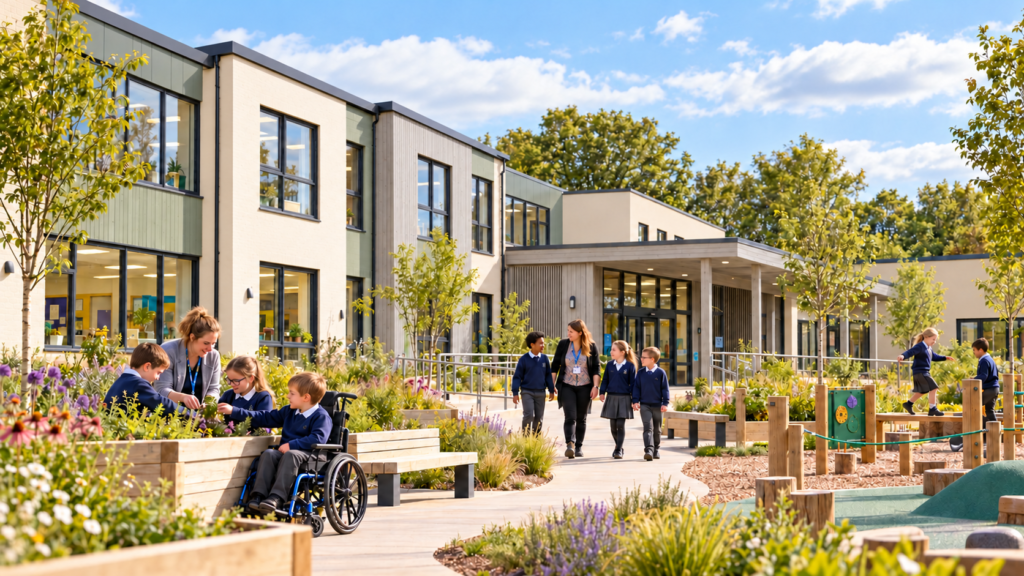
Modern School
A school can look perfectly ordinary from the outside. It has classrooms, staff, pupils and a timetable to keep.
Yet a special school may also have ceiling hoists, sensory rooms, adapted minibuses, specialist therapy equipment and pupils who need individual support throughout the day.
That changes the insurance question considerably.
Special school insurance is not simply about protecting a building. It is about understanding the people, activities, equipment and responsibilities that make each setting different.
For school leaders, the challenge is not just finding an affordable policy. It is knowing whether that policy reflects the school they actually run.
At Cornerstone Insurance, we help education providers explore specialist insurance options for the risks that standard arrangements may not fully address.
Why Is Special School Insurance Different?
Insurance works by assessing risk. However, not every school presents the same risks.
A mainstream classroom and a specialist learning environment may share many characteristics, but their day-to-day requirements can differ significantly.
For example, some SEND settings provide personal care, physiotherapy or hydrotherapy alongside education. Others operate residential accommodation or transport pupils in adapted vehicles.
Each additional activity can affect the school’s insurance requirements.
Specialist equipment may also cost more to replace than standard classroom furnishings. Meanwhile, a building designed around accessibility may require specific adaptations if it suffers serious damage.
The important point is that a policy designed for a typical school may not automatically cover every specialist activity.
The question is not whether your school has insurance. It is whether your insurance reflects how your school operates.
What Does Insurance for Special Schools Need to Cover?
There is no single package that suits every SEND provider. Nevertheless, several areas deserve careful consideration when reviewing your arrangements.
1. Employers’ Liability Insurance
Your staff are central to the school’s work. Their responsibilities may include personal care, manual handling and supporting pupils with complex needs.
In the UK, employers’ liability insurance is generally compulsory when you employ staff, subject to limited exemptions. The statutory minimum level of cover is usually £5 million, although policies commonly provide £10 million.
However, the limit is only part of the picture.
Insurers also need an accurate understanding of the activities staff undertake. For example, manual handling, physical intervention and the use of agency workers may affect the risk assessment.
Therefore, make sure your insurer has a clear picture of your staffing arrangements, training and procedures.
2. Public Liability and Pupil-Related Risks
Schools have responsibilities towards pupils, parents, visitors and other people who interact with their activities.
Public liability insurance can protect against certain claims involving third-party injury or property damage.
For SEND settings, it is particularly important to check the scope of cover. Off-site visits, specialist therapies, physical intervention and other activities may need specific consideration.
In addition, local authority commissioning agreements may specify minimum liability limits.
Review those requirements alongside your policy rather than assuming that a standard limit will always be sufficient.
3. Safeguarding and Abuse Cover
Safeguarding is fundamental to every school. However, the insurance arrangements supporting it deserve equally careful attention.
Claims involving alleged abuse or failures in safeguarding can be complex. Some policies may exclude particular claims, restrict cover or impose specific conditions.
The basis on which a policy responds also matters. For example, claims-made cover generally depends on when a claim is made and reported, subject to the policy terms.
Consequently, changing insurers without checking these details could create an unwanted gap in protection.
When reviewing your policy, ask about the cover limit, exclusions, reporting requirements and any applicable retroactive date.
It is also worth checking whether the protection extends to the school’s full range of activities and responsibilities.
4. Buildings, Contents and Specialist Equipment
A school building is more than bricks and mortar.
In a specialist setting, the premises may include accessible bathrooms, ceiling track hoists, adapted classrooms and bespoke sensory facilities. Replacing these features after serious damage can be more complicated than repairing an ordinary building.
As a result, an inaccurate rebuild valuation could leave the school underinsured.
Contents also deserve attention. Communication aids, mobility equipment, specialist ICT and therapy resources can represent a significant investment.
Review your buildings and contents sums insured regularly. Where necessary, obtain a professional rebuild valuation and make sure specialist adaptations are included.
5. Business Interruption Insurance
Imagine that a fire or flood makes your school building unusable.
The immediate concern is the damage itself. However, the consequences may extend much further.
Finding suitable alternative premises, restoring specialist facilities and arranging the return to normal provision can take time. Meanwhile, certain costs may continue.
Business interruption insurance can help protect against specified financial losses following insured damage, depending on the policy.
For this reason, consider whether the indemnity period is long enough to reflect a realistic recovery scenario.
A short period may not be appropriate if reinstating adapted premises is likely to take longer. Discuss the likely timescales, continuing expenses and relevant income streams with your broker.
6. Minibuses and School Transport
Transport can be essential for pupils who need accessible vehicles or additional support while travelling.
However, a vehicle is not adequately protected simply because it has motor insurance.
Check that the policy reflects its business use, the passengers carried and any relevant adaptations. Driver eligibility and licence requirements should also be confirmed for the particular vehicle and circumstances.
Furthermore, wheelchair lifts, restraint systems and other specialist equipment may need specific attention.
If your school operates several vehicles, a fleet policy may be worth comparing with individual arrangements. The most suitable option will depend on your circumstances and the cover offered.
7. Cyber Insurance and Sensitive Data
Special schools hold highly sensitive information, including medical details, education plans and safeguarding records.
A cyber incident could disrupt systems, affect access to records and create difficult communication responsibilities.
Cyber insurance may help with certain costs arising from covered incidents. Depending on the policy, this could include incident response, data recovery and specified liability claims.
However, insurance is only one part of the solution.
Strong access controls, reliable backups, staff training and an effective incident response plan are also important.
Review your cyber arrangements alongside your wider data protection and safeguarding procedures.
8. Professional Indemnity and Specialist Care
Some SEND providers employ therapists, nurses or other professionals who deliver services beyond classroom teaching.
In these circumstances, professional indemnity or medical malpractice cover may be relevant.
The appropriate protection depends on the services provided, the responsibilities accepted and the policy wording.
Therefore, schools should disclose the full range of activities undertaken. Do not assume that a general education policy automatically covers every professional service.
Residential Schools and Alternative Provision
Not every SEND setting operates in the same way.
Residential special schools may provide care around the clock. Their insurance needs can therefore differ from those of a day school.
For example, the policy may need to reflect residential activities, staffing arrangements, overnight supervision and any separately regulated care provision.
Alternative provision can present a different set of challenges. Pupil numbers may change frequently, and activities may take place away from the main premises.
Consequently, it is important to check that the policy reflects the actual activities, locations and services delivered.
The more accurately an insurer understands the operation, the easier it is to assess whether the proposed cover is appropriate.
Six Common Special School Insurance Mistakes
Even well-managed schools can overlook important details when arranging cover.
Here are six areas worth checking.
-
Assuming all activities are covered. Personal care, therapies and physical intervention may require specific disclosure or confirmation.
-
Overlooking safeguarding exclusions. Check the limits, conditions and basis on which claims are handled.
-
Underestimating rebuild costs. Specialist adaptations can make reinstatement more expensive than expected.
-
Choosing an unsuitable interruption period. Consider how long it could take to restore specialist facilities.
-
Forgetting vehicle requirements. Confirm the use, drivers and adaptations of every school vehicle.
-
Failing to review changing activities. New services, additional pupils or different staffing arrangements may alter the school’s risk profile.
A review does not automatically mean you need more insurance. Instead, it helps you identify what is already covered, what may be missing and which questions need answering.
How Cornerstone Insurance Helps SEND Settings
Insurance should begin with understanding the organisation, not simply selecting a policy from a list.
Cornerstone Insurance is an independent insurance broker based in Leicester. We help schools, care providers and other organisations explore cover for specialist and difficult-to-place risks.
We recognise that a special school may need a different approach from a standard education setting.
That is why understanding your activities, premises, staffing and responsibilities is an important part of the conversation.
We can help you review your existing arrangements, discuss potential gaps and explore options available through relevant insurance markets.
In addition, every client has a dedicated account handler, giving you a point of contact for discussing your requirements.
Where a serious property loss occurs, access to specialist loss-adjusting support may also be valuable. The appropriate support will depend on the circumstances and the arrangements available.
Our aim is to help you make informed decisions about protecting your school, its people and its ability to continue providing education.
Frequently Asked Questions About Special School Insurance
Is special school insurance a legal requirement?
Some types of insurance are compulsory in particular circumstances. For example, employers’ liability insurance is generally required when a school employs staff, subject to limited exemptions. Motor insurance is also legally required for vehicles used on public roads.
Other cover may be required by contracts, funding arrangements or the school’s particular activities. The appropriate requirements should be checked for each setting.
Are maintained special schools automatically insured by the local authority?
Some maintained schools benefit from local authority insurance arrangements or the Department for Education’s Risk Protection Arrangement, where eligible.
However, the precise protection varies. Schools should confirm in writing what is covered, including trips, vehicles, income streams and specialist activities.
Academies and independent schools may have different arrangements.
How much does special school insurance cost?
There is no reliable single price for every special school.
Premiums can depend on pupil numbers, activities, premises, residential provision, transport, claims history and the cover required.
Rather than comparing premiums alone, consider the scope of cover, exclusions, limits and suitability for your school.
Can Cornerstone help if another insurer has declined cover?
A refusal from one insurer does not necessarily mean that suitable cover is unavailable.
Different insurers assess risks differently. Cornerstone can discuss your circumstances and explore whether appropriate specialist markets may be available. Acceptance cannot be guaranteed.
Does Cornerstone only work with schools in Leicester?
Cornerstone is based in Leicester and supports education and care providers across the wider East Midlands and beyond, subject to its service arrangements.
Contact the team to discuss your school’s location and requirements.
Review Your Special School Insurance with Cornerstone
Your school has its own pupils, facilities, staff and responsibilities. Its insurance should reflect those realities.
A policy that looks satisfactory on paper may still need closer examination if it does not account for specialist equipment, safeguarding, transport or the full range of services you provide.
The sensible first step is to understand what your current arrangements cover.
Contact Cornerstone Insurance on 0116 3440 040 to discuss your special school insurance requirements and arrange a review of your existing cover.
You can also visit the Cornerstone Insurance website to get in touch.
Because protecting a specialist school means understanding what makes it special.
All insurance is subject to the relevant insurer’s terms, conditions, limits and exclusions. Legal requirements and the availability of cover depend on the circumstances of each organisation. This article provides general information and is not a substitute for individual insurance or legal advice.